
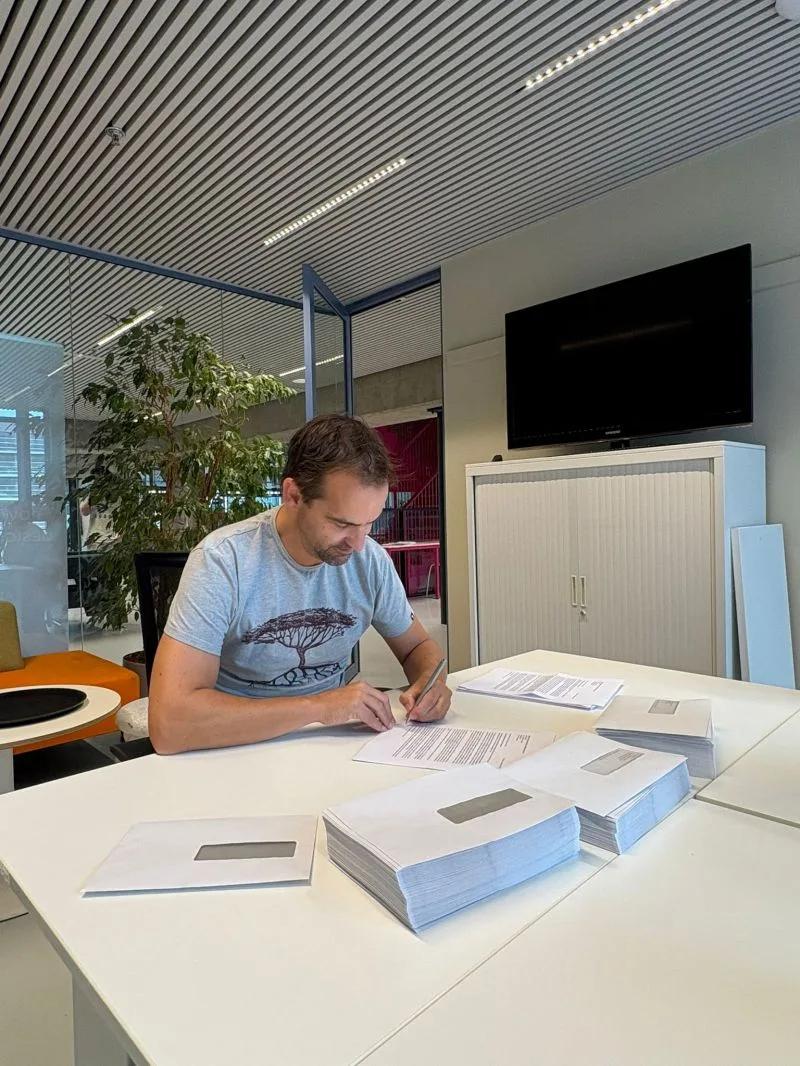
At Helixiora, we've made a decision that might seem unusual for an AI company. We're deliberately automating less of one part of our business.
We're sending handwritten letters to a carefully selected group of companies.
Not because AI has failed us, but because we've reached a point where automating every interaction doesn't necessarily create more value.
As a company that helps organisations use data, AI and automation more effectively, this might sound contradictory.
But we believe good technology decisions aren't about automating everything. They're about understanding where technology adds value and where human attention still matters.
When does automation stop adding value?
Automation is incredibly useful when it saves time, reduces errors or helps people make better decisions. But that doesn't mean every activity benefits equally from being automated.
Consider B2B sales and outreach.
Today, AI tools can research companies, identify decision-makers, organise information and generate personalised messages in a fraction of the time it once took.
That's a significant advancement.
But it has also created an interesting problem.
Our inboxes are increasingly filled with messages that appear personal but often have very little human involvement behind them.
"I've been looking into your company and noticed..."
We've all seen some version of that opening.
But has someone genuinely taken the time to understand the organisation? Have they considered its challenges and opportunities? Or has a system simply generated another message using a few publicly available details?
The technology may be impressive.
The human connection can feel remarkably absent.
And that's where we believe automation starts to lose some of its value.
Why handwritten letters?
At Helixiora, we've decided to experiment with a different approach.
Rather than contacting as many companies as possible, we've selected a smaller group of organisations where our initial research suggests we could genuinely add value.
Each of these companies receives a personal, handwritten letter.
It's not a generic sales pitch distributed to hundreds of businesses. It's an introduction based on what we've taken the time to learn about that particular organisation.
Writing and sending a physical letter takes more effort than launching an automated email campaign.
That's intentional.
We want to be more selective about who we approach, why we're approaching them and what we believe we might be able to contribute.
The objective isn't to send more messages.
It's to start more meaningful conversations.
We're still using AI. Just differently.
Choosing handwritten letters doesn't mean we're abandoning AI in our outreach process.
Quite the opposite.
AI plays an important role in helping us conduct more thorough and efficient research before making contact.
Using AI alongside publicly available information, we can explore how a company operates, the market it serves and developments that may influence its business.
We can identify potential opportunities involving data management, process automation, business intelligence and practical AI applications.
We also consider possible risks.
These might include data quality, information security, fragmented systems or whether an organisation is sufficiently prepared to adopt AI responsibly.
This gives us a useful starting point for understanding where data and AI might make a difference.
But it's still only a starting point.
What AI can't tell us from the outside
An organisation is much more than the information available online.
Public websites, company announcements, industry reports and other sources can reveal a great deal.
But they can't tell you everything about how a business actually operates.
They don't necessarily reveal which processes frustrate employees, where information gets lost or which internal projects are already underway.
They can't reliably tell you what leadership is prioritising, what resources are available or which challenges are most urgent.
For that, you need to speak to people.
Ask questions. Listen. Challenge your assumptions.
And sometimes discover that your original understanding was completely wrong.
That's why we don't treat AI-assisted research as a finished assessment.
We treat it as preparation for a conversation.
AI helps us arrive better informed. People help us understand the full picture.
From a handwritten letter to a Data & AI Leadership Check-in
The handwritten letter is the first step in our approach.
After sending it, we follow up with a personal phone call.
The purpose isn't to immediately sell a solution. It's to understand whether our initial assessment reflects what the organisation is actually experiencing.
Do the opportunities we've identified make sense? Are the challenges relevant? What important context are we missing?
When there's a good reason to continue the conversation, we combine our external research with the organisation's internal knowledge to complete a Data & AI Leadership Check-in.
This brings together two valuable perspectives.
The first is what we can identify from the outside using AI, research and publicly available information.
The second is what the people running the business know from their day-to-day experience.
Together, these perspectives help establish where data and AI could create practical value, which risks need attention and what the next steps might look like.
Sometimes that means identifying a promising AI application.
Other times, the priority may be improving existing processes, organising data or developing a clearer strategy before introducing new technology.
Both can be valuable outcomes.
The future doesn't have to be fully automated
We believe strongly in the potential of AI.
We work with it every day, helping organisations use technology to solve real business problems.
But understanding what AI can do also means recognising when it isn't the right tool for the entire job.
Not every human interaction needs to be automated.
Not every personalised message becomes more meaningful because AI can generate it.
And not every efficiency gain translates into greater business value.
Sometimes the smarter approach is to let technology handle the research and preparation, then make the time for a genuine human conversation.
Or, in our case, to pick up a pen and write a letter.
What does this mean for your business?
The balance between automation and personal attention goes well beyond sales and marketing.
The same questions apply to customer service, recruitment, internal communications and many other business processes.
Where can automation genuinely help people work better? And where might it remove the human attention that makes an interaction valuable?
These are questions worth asking before automating any process.
At Helixiora, we'll continue to explore that balance in our own work and in the solutions we develop with clients.
Use AI where it works better. Stay human where it matters.
Curious about where data and AI could create value in your organisation? Explore what we do at helixiora.com and start a conversation with us.